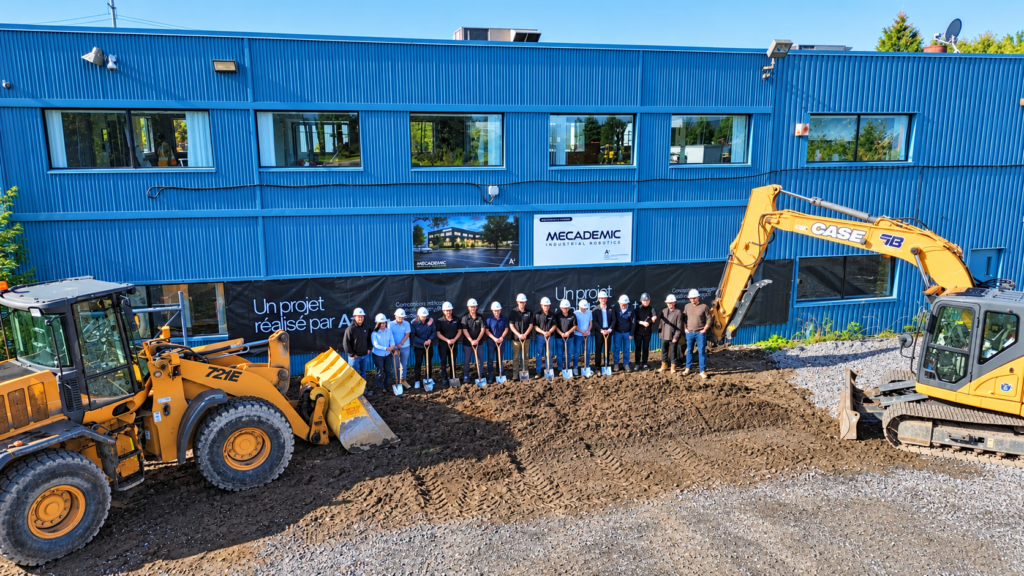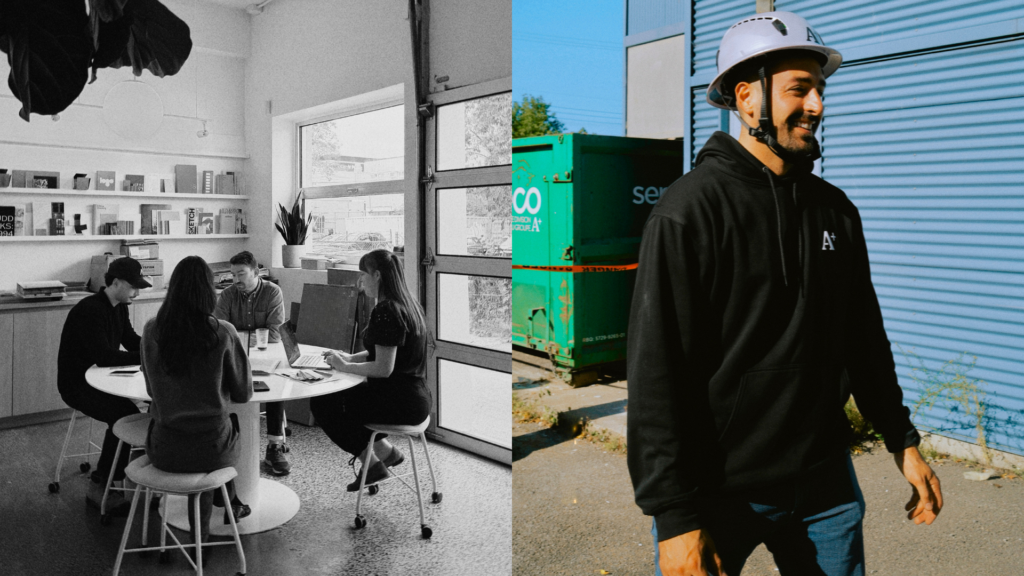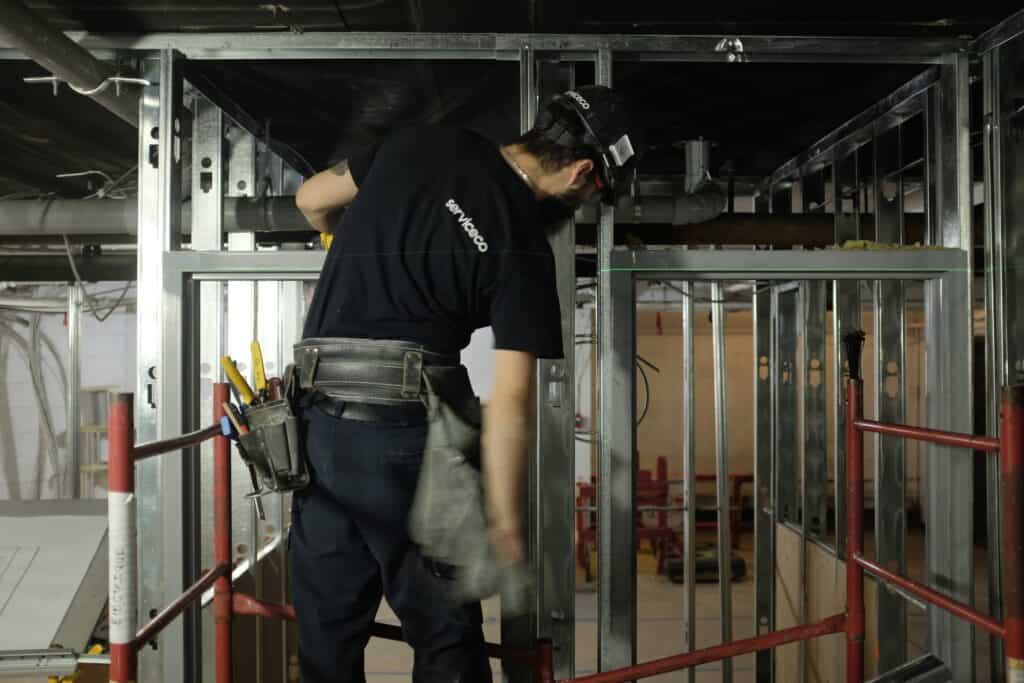
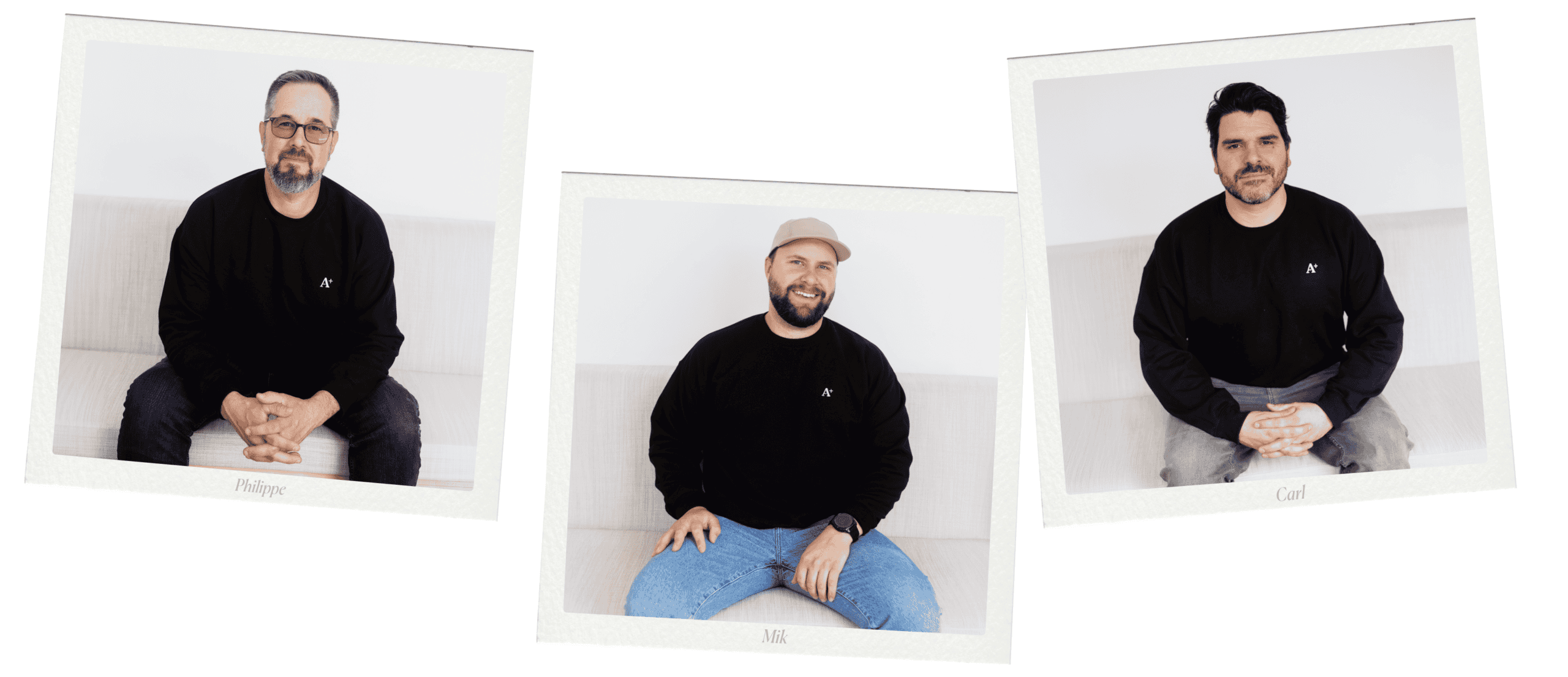
On the job site, the day starts before sunrise. Mik, Philippe and Carl are superintendents at A+, three people on the ground who manage projects, teams, surprises, and decisions that can’t wait. Behind every delivered project, there are hundreds of details no one ever sees: the plans they question, the subcontractors they chase down, the problems they solve before the client ever hears about them. That’s their day-to-day. We asked them 10 questions, the same ones for all three. No staging, no prepared answers. Just their vision of the trade, as it is.
〉What time does your day start, and when does it end?
P: Up at 3:40, on site by 5:30. My day wraps up with the team around 1:45 PM, but it’s far from over: daily report at 2:00 PM, site purchases on the way home. Office meetings happen after those hours. Site meetings, early in the morning between 6 and 8.
M: 5:45, 6:00 AM, sometimes 4:00 AM when noise restrictions require it. I finish before 3:30 PM, except Tuesdays or when meetings run long. I give tasks to the crew lead the night before, mornings start with emails, and the rest of the day is spent supervising, coordinating tools and materials, and reviewing plans.
C: Officially 5:30 to 3:00 PM, but honestly, the door is never really closed. A text in the evening, some thought about the weeks ahead, and the day stretches in my head long after.
〉What’s the one thing you do every day that nobody ever sees?
P: Making sure all the stakeholders, subcontractors and the A+ team, are communicating and staying focused on the same goal. The invisible coordination that holds everything together.
M: Risk mitigation. Questioning every point in the plans, catching mistakes before they get expensive. Everyone sees the clean result, nobody sees the dozens of problems avoided upstream.
C: The P3Ss. A schedule people only see as a result, but behind it: dozens of calls to confirm everyone on the right dates, and several hours of reflection to make sure nobody’s missing at the wrong moment.
〉What’s the roughest part of your job right now?
P: When subcontractors don’t follow the plans because of unexpected elements and you have to find solutions on the spot to create a win-win situation for everyone.
M: The stress and the hours. Sometimes the feeling of being the only one responsible for meeting deadlines, even when it’s a team effort.
C: Managing the tenants on our real estate projects. Doing construction work while there are both existing and new tenants on site, without upsetting anyone and while keeping everyone safe, that brings its share of daily complications.
〉Tell me about a recent unexpected issue that threw everything off. How did you recover?
P: An incident between subcontractors following a crew change mid-project. Meetings with the RSS representatives from each party, a redefinition of objectives, and the removal of the people causing the problem.
M: Hard to name just one, it happens almost every day. That’s the reality of the job site.
C: During an excavation on one of our projects, we hit rock. Work stopped, team gathered, impromptu brainstorm. We reworked the game plan by thinking outside the box, and delivered without blowing the budget.
〉What’s the difference between working in design-build versus a traditional project, from your perspective on the ground?
P: The ability to make a difference quickly. I can really put my mark on the structure, the coordination, and the final result.
M: More flexibility in decisions, and above all, the speed at which they get made. More control over construction methods and materials.
C: I haven’t done design-build yet, a perspective to come, I look forward to exploring that!
〉What’s your best moment of the day, the moment when you’re in your element?
P: Quick decision-making and tight follow-ups. That’s where I concretely feel my impact on the project.
M: After lunch, when the distractions fade and I can really think. And sometimes very early in the morning, before even getting to the site.
C: Out in the field with the workers, finding solutions to complex situations. Building game plans with my team, that’s where I’m in my element.
〉Do you have a job site story that still makes you smile, or a project you’re particularly proud of?
P: Wizard, Fitzrovia, and taking back control of the Westmount clinic. Projects where I had to turn things around, and where I felt like we succeeded.
M: The sound studios at Invoke. The client invited us to watch a movie with Dolby sound. It was the result of not just building a space, but truly living what we created.
C: The CAMI clinic at Charles-Lemoyne Hospital: about twenty doctors’ and nurses’ offices, a large waiting room, a lot of coordination. Delivered on time, flawless result. A project I’m still proud of.
〉How do you handle a subcontractor who isn’t delivering? Concretely, what do you do?
P: First I establish a collaborative relationship. If nothing changes: a formal email with the outstanding tasks, new imposed deadlines, and the project managers from both sides copied.
M: I set firm boundaries and make it clear that it’s unacceptable. No room for ambiguity.
C: First, diplomacy. Then, if that’s not enough, persistence, the more consistent you are in your requests, the more the subcontractor will want to deliver just to get some peace. As a last resort, find their leverage point. But usually, we settle it without conflict.
〉What has this trade taught you that you couldn’t have learned anywhere else?
P: That the value of my actions and the discipline I bring are genuinely recognized, and I credit the A+ leadership team for that.
M: Stress management and problem-solving. Skills you don’t learn from a book.
C: To figure things out on my own. Even in a team environment, you’re often alone in your world. And quick thinking: getting challenged by others and knowing how to find the right answer fast so you don’t look lost.
〉If you had to explain to someone why you still get up in the morning to go to the job site, what would you tell them?
P: I consider myself privileged. My work provides for my family, in an exceptional trade and an exceptional company.
M: It’s rough, but it’s rewarding. Seeing the final result and people’s reactions, there’s not much else that compares.
C: The challenge. Not a single day without one. The days fly by, you have to push yourself, and that’s what makes it great. And the people around you: at A+, I found a team that’s genuinely easy to work with.
Three different paths, three ways of approaching the trade , but the same common thread : a quiet pride in work well done, and the drive to do it all over again the next morning before the city wakes up. At A+, that’s what we call having the right people on the ground.
Frequently asked questions
In the traditional model, you sign separate contracts with the architect, engineers and contractor, each defending their own interests. With integrated project delivery, a single team designs and builds your space under one contract, with a shared target budget and open-book transparency. You make the decisions; we coordinate execution from start to handover.
Coordinating the architect, engineers and trades yourself means juggling multiple contracts, multiple invoices and shared blame when something goes wrong. With one contract, you have a single point of contact accountable for budget, schedule and outcome. The expertise is already aligned and used to working together, which removes the coordination errors that drive most delays.
We set a target budget at the drawing stage using real data from comparable projects, then design within that budget instead of discovering the price at the end. The agreed price does not change unless you request modifications or different materials. Any hidden condition we uncover along the way is on us.
No. The total cost is usually lower and, above all, more predictable. Bringing design and construction under one contract removes stacked margins, the change orders that come from conflicting drawings, and rework. Open-book transparency shows you where every dollar goes. You pay the real cost of the work, not a chain of middlemen.
Timelines depend on size and complexity, but the integrated approach shortens them because design and construction advance in parallel rather than in sequence. As an example, we delivered the 14 Red Bull Music Academy studios in 18 days. By the second meeting you already have a preliminary budget and drawings to plan around.
Far less than with several vendors to coordinate. You have one point of contact who manages the architect, engineers and trades for you. You keep the important decisions; we handle the daily coordination, follow-ups and on-site surprises. In practice, your role comes down to approving key milestones on an agreed communication routine.
We fit out commercial spaces of every kind: offices, medical clinics, restaurants, retail and industrial spaces, across Greater Montreal and up to roughly 90 minutes from the surrounding region. Our projects run from about 2,000 to 60,000 square feet. Our work includes studios, clinics, factories and pre-built suites for landlords and brokers.
The budget agreed at the drawing stage is guaranteed: any overrun that does not come from a change you requested is on us, not you. Hidden conditions uncovered on site are our responsibility too. For schedule, phased planning and one integrated team cut delays at the source. We deliver turnkey, so your teams can move in the next day.