6 things you won’t read in an A+ job posting
A job posting describes a role. It lists tasks, required skills, and sometimes a salary range. But it never really describes what it’s like to work somewhere day to day: how the days unfold, how people talk to each other, what makes a week tough or, on the contrary, satisfying.
Here are six things we don’t mention in our postings but that are part of the reality at A+, in both directions: what we love, and what takes some adjusting. We’d rather be upfront about it than let people find out after they’ve signed.
01 _ A very fast pace
In design-build, everything happens under one roof (design, engineering, management, construction), which means things move fast, often in parallel. Deadlines are tight, projects overlap, and there isn’t much downtime between two decisions. A file can go from feasibility to site mobilization in a matter of weeks, and you need to be able to keep up without losing the thread.
For some people, that pace quickly becomes a source of energy: you’re moving forward, you see things happen, you never have time to get bored. There’s something stimulating about working on several projects at once, watching one site rise out of the ground while you’re already preparing the bid for the next.
For others, it can be harder to sustain over time, especially if you need more predictability or quieter moments to breathe between files. Both reactions are legitimate, and it’s not up to us to decide which one is right for you. We’d just rather name it clearly from the start than let someone discover it after the fact, once they’re on board.
02 _ A strong sense of belonging
People who stay at A+ often develop a real attachment to the team and to the projects they deliver. It’s not something we impose. It comes from the fact that teams are small, everyone knows each other’s files, and you see the concrete result of your work rise out of the ground. There’s a difference between working on an abstract project and being able to go to the site and see with your own eyes what you helped build.
That sense of belonging is also built through specific rituals. Every two weeks, we hold the Point A+: everyone gathers at the office, in the same room, to talk about company news, ongoing projects, and what’s coming up. People on job sites join us on Teams, so everyone stays in the loop no matter where they’re working that day. There’s also a space where people can ask their questions, anonymously or not, and we answer them together, in front of everyone rather than in private.
03 _ Lots of group activities
There are regular opportunities to get together outside of project meetings, whether informal or organized. It’s not mandatory, but it’s there, and it’s part of how the team gets to know each other beyond tasks and deliverables.
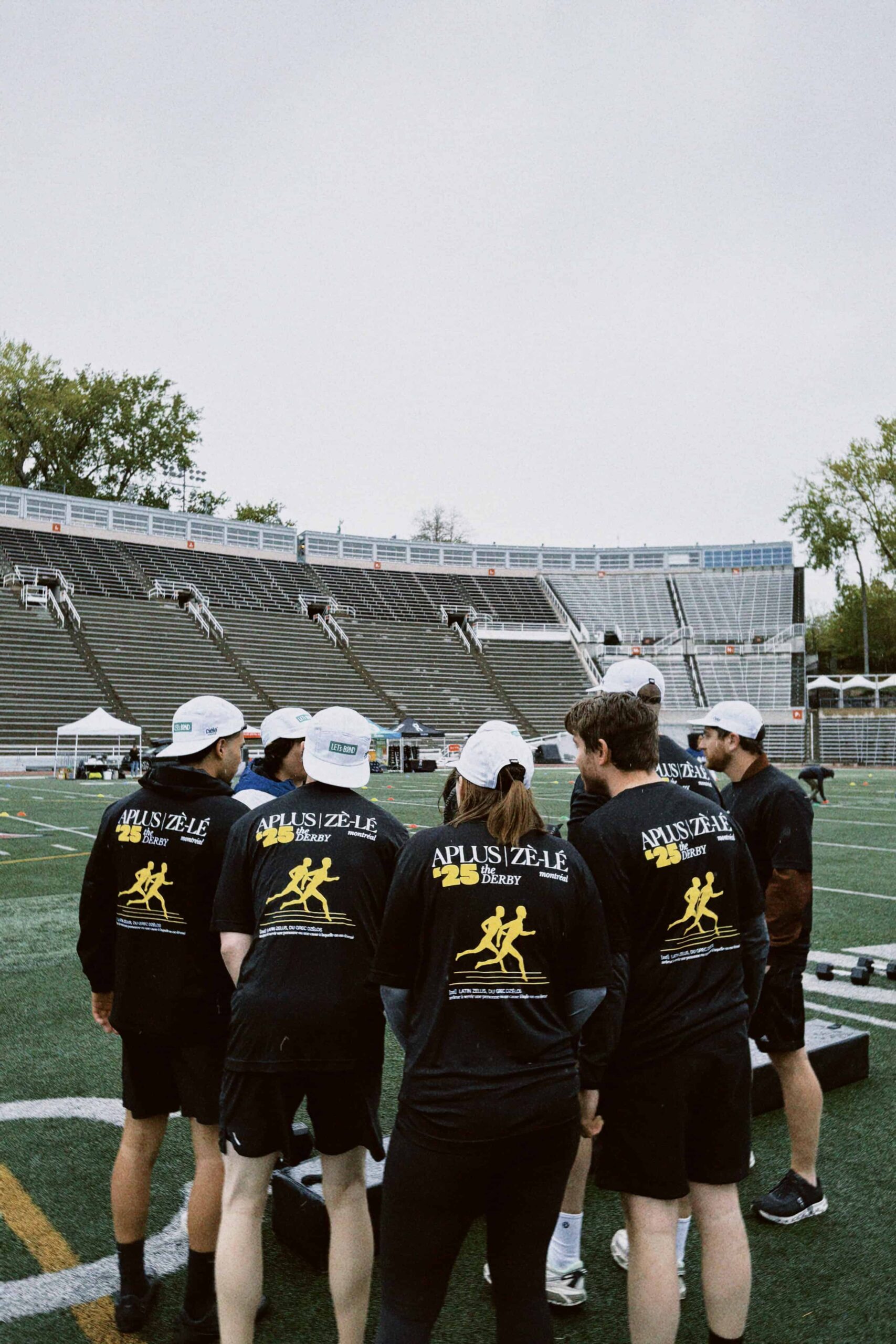
It takes many forms throughout the year: the Christmas party, the summer party, the annual golf tournament, and plenty of more spontaneous happy hours. These are moments when we get together without talking about job sites or schedules, just to spend time with each other.
There are also team offsites, but those serve a different purpose. They’re not about socializing; they’re about giving ourselves a space to focus 100% on deep work, away from the day-to-day interruptions, the emails, and the back-to-back meetings. Two types of gatherings, two goals, but in both cases, the idea is to step out of the usual office rhythm.
04 _ Decisions made close to the ground
Because everything is integrated under one roof, decisions don’t always have to climb a long chain of approvals. Often, the person who spots the problem is also the one who helps solve it, without waiting for three sign-offs before acting. That calls for a bit more initiative than in a more siloed structure, and it can be surprising at first, especially if you come from an environment where every decision goes through several levels.
We’ve actually talked about this in more detail before: it’s the choice we make to bet on trust rather than control, even though we’re the first to admit we don’t always get it perfectly right. Betting on autonomy means accepting that things won’t always be done exactly the way you would have done them yourself, and that’s a balance we keep adjusting.
05 _ A workload that varies with project phases
The pace isn’t constant throughout the year, or even from one month to the next. Some phases (bid deadlines, site mobilization) are noticeably more intense than others, with busier days and priorities that shift quickly. Other periods are calmer, better suited to planning or thinking ahead to upcoming projects.
It’s the kind of thing you learn to anticipate with experience, but that no one can guess just by reading a job title. It also takes some flexibility: accepting that the intensity of one week isn’t necessarily representative of all the others.
06 _ A feedback culture we’re still working on
We try to name what’s not working rather than let a problem drag on. It’s not perfect yet: giving and receiving feedback is still something we’re working on as a team, and we don’t claim to have all the answers.
We know it’s not always easy to give. It takes a bit of courage, one of our values, to tell a colleague something that might not land well. But that small effort is exactly what allows us to improve and become better colleagues for one another.
It matters to us, enough that we dedicate real time to it. We took part in a workshop over two half-days inspired by the principles of Nonviolent Communication (NVC), designed to help us better understand our needs and emotions, develop our ability to offer clear and caring feedback, and learn to receive other people’s feedback with curiosity rather than defensiveness. It’s deep work that doesn’t get solved in a single training session, but we keep nurturing it intentionally rather than leaving it to chance.
In short
We could have written a piece that only sells the positives: the sense of belonging, the activities, the autonomy. It would have been simpler, but it would also have been incomplete. The fast pace and the workload that shifts with each phase are as much a part of the experience as everything else, and we’d rather you know that before you apply than after your first month.
This piece doesn’t say everything, and it will probably evolve over time as we keep getting to know ourselves better as a team. If this speaks to you, we want to talk to you.


Frequently asked questions
In the traditional model, you sign separate contracts with the architect, engineers and contractor, each defending their own interests. With integrated project delivery, a single team designs and builds your space under one contract, with a shared target budget and open-book transparency. You make the decisions; we coordinate execution from start to handover.
Coordinating the architect, engineers and trades yourself means juggling multiple contracts, multiple invoices and shared blame when something goes wrong. With one contract, you have a single point of contact accountable for budget, schedule and outcome. The expertise is already aligned and used to working together, which removes the coordination errors that drive most delays.
We set a target budget at the drawing stage using real data from comparable projects, then design within that budget instead of discovering the price at the end. The agreed price does not change unless you request modifications or different materials. Any hidden condition we uncover along the way is on us.
No. The total cost is usually lower and, above all, more predictable. Bringing design and construction under one contract removes stacked margins, the change orders that come from conflicting drawings, and rework. Open-book transparency shows you where every dollar goes. You pay the real cost of the work, not a chain of middlemen.
Timelines depend on size and complexity, but the integrated approach shortens them because design and construction advance in parallel rather than in sequence. As an example, we delivered the 14 Red Bull Music Academy studios in 18 days. By the second meeting you already have a preliminary budget and drawings to plan around.
Far less than with several vendors to coordinate. You have one point of contact who manages the architect, engineers and trades for you. You keep the important decisions; we handle the daily coordination, follow-ups and on-site surprises. In practice, your role comes down to approving key milestones on an agreed communication routine.
We fit out commercial spaces of every kind: offices, medical clinics, restaurants, retail and industrial spaces, across Greater Montreal and up to roughly 90 minutes from the surrounding region. Our projects run from about 2,000 to 60,000 square feet. Our work includes studios, clinics, factories and pre-built suites for landlords and brokers.
The budget agreed at the drawing stage is guaranteed: any overrun that does not come from a change you requested is on us, not you. Hidden conditions uncovered on site are our responsibility too. For schedule, phased planning and one integrated team cut delays at the source. We deliver turnkey, so your teams can move in the next day.