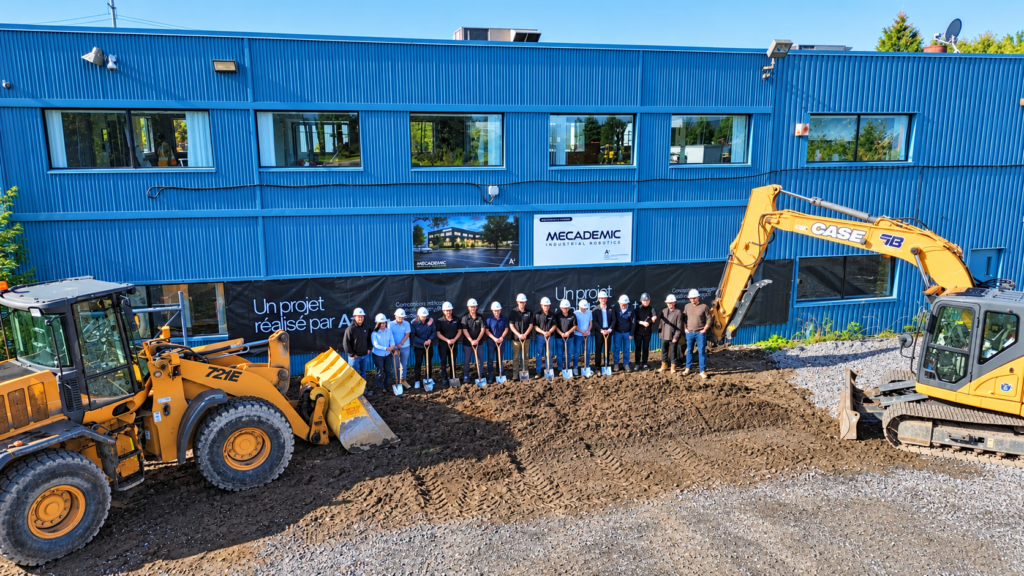
A+ is taking a major step forward. We’re launching A+ Industrial, a division fully dedicated to integrated industrial projects – and we’re putting Nicola Mocchiutti in charge of building it, as he joins our team as Managing Director of this new division.
Why a division, not just a new service
We could have settled for adding “industrial” to our list of offerings. That’s not what we’re doing.
A+ Industrial will have its own growth strategy, its own operating model, and its own dedicated team. At the same time, it builds on what already makes A+ strong: the agility of an entrepreneurial firm and an integrated project platform, where design, management, and construction move forward under one roof, with a single point of contact accountable for the outcome.
That distinction is what matters: we’re not slapping a new label on an existing model – we’re building a team designed from the ground up for the realities of the private industrial, commercial, and institutional market.
Meet Nicola Mocchiutti
 Nicola joins A+ after nearly 12 years at Broccolini, where he moved from construction management to real estate development, then to business development leadership. There, he played a lead role in several major projects across Quebec and Ontario, particularly in the industrial, manufacturing, and logistics sectors.
An engineer by training, he began his career at Bombardier Aerospace. That combination – a technical foundation followed by years in business and development – gives him a sharp read on the operational challenges facing industrial clients, along with a wide network of owners, users, brokers, professionals, and partners across the sector.
His mandate at A+ is clear: build, position, and grow A+ Industrial.
A vision aligned with A+’s
Nicola could have chosen several paths after Broccolini. He chose A+ for one specific reason: our integrated model, built to support industrial clients with a single point of contact, from strategic thinking through to delivery, working closely with the architects, engineers, and professionals who make a project succeed.
In his words:
“After my last few years, I was looking for an entrepreneurial challenge that matched my experience. What convinced me about A+ is its integrated model approach, designed from the ground up for the realities of industrial clients. I arrive with my knowledge, my relationships and a very clear intention: to build a team recognized for its rigour, its agility, and its ability to deliver projects.”
– Nicola Mocchiutti
A strategic role in service of our clients
With Nicola leading A+ Industrial, we’re strengthening our ability to:
- support owners, developers, and industrial users at the earliest stages of project thinking – well before the first sketch;
- offer a dedicated structure – its own growth strategy, its own operating model, its own team – rather than an offering bolted onto existing operations;
- deliver new industrial projects with the same promise that holds everywhere at A+: no friction, no surprises, guaranteed costs and schedules.
What this means for our clients and partners
In practical terms, A+ Industrial is already bringing together top talent and partners to assemble a high-caliber team dedicated to industrial projects.
Nicola’s arrival adds considerable depth to our organization. His experience, his leadership, and his ability to turn an opportunity into a concrete project will be important assets for A+, our partners, and above all, our clients.
Have a project in mind, or questions for Nicola?
Have an industrial project in mind? Looking for the next chapter in your career? Write to Nicola and connect with him on LinkedIn. Now is the perfect time!
Tell us about your project!
Do you have a real estate project in mind, but don’t know where to start? We can help! Contact us now to learn more about our services and discuss your project!

Frequently asked questions
No. The total cost is usually lower and, above all, more predictable. Bringing design and construction under one contract removes stacked margins, the change orders that come from conflicting drawings, and rework. Open-book transparency shows you where every dollar goes. You pay the real cost of the work, not a chain of middlemen.
We set a target budget at the drawing stage using real data from comparable projects, then design within that budget instead of discovering the price at the end. The agreed price does not change unless you request modifications or different materials. Any hidden condition we uncover along the way is on us.
Timelines depend on size and complexity, but the integrated approach shortens them because design and construction advance in parallel rather than in sequence. As an example, we delivered the 14 Red Bull Music Academy studios in 18 days. By the second meeting you already have a preliminary budget and drawings to plan around.
Overruns come mostly from incomplete designs at bid time, hidden conditions found on site, mid-project change requests and siloed trades. The integrated approach lowers those risks: design and construction under one contract, a budget guaranteed from the drawing stage, and hidden conditions on us.
The budget agreed at the drawing stage is guaranteed: any overrun that does not come from a change you requested is on us, not you. Hidden conditions uncovered on site are our responsibility too. For schedule, phased planning and one integrated team cut delays at the source. We deliver turnkey, so your teams can move in the next day.
In the traditional model, you sign separate contracts with the architect, engineers and contractor, each defending their own interests. With integrated project delivery, a single team designs and builds your space under one contract, with a shared target budget and open-book transparency. You make the decisions; we coordinate execution from start to handover.
When the architect, engineers and contractor work separately, no one owns the whole. Drawings conflict, rework piles up, schedules stretch and each party protects its own margin. Bringing design and construction under one contract removes that friction and the hidden costs it creates.
Coordinating the architect, engineers and trades yourself means juggling multiple contracts, multiple invoices and shared blame when something goes wrong. With one contract, you have a single point of contact accountable for budget, schedule and outcome. The expertise is already aligned and used to working together, which removes the coordination errors that drive most delays.